Planet Debris Pollute Dead Stars
A pair of dead stars sitting in a star cluster about 150 light years from Earth appear to have their atmospheres polluted with debris from asteroids . Astronomers say this suggests that the basic ingredients for making Earth-like planets could be quite common in stellar nurseries across the cosmos.
“We have identified chemical evidence for the Lego building blocks of rocky planets,” says Jay Farihi, lead author of a new study in a NASA statement .
The strange discovery was made thanks to the Hubble Space Telescope’s view of two burnt-out cores of white dwarf stars. The orbiting observatory was able to determine the chemical fingerprints of their stellar atmospheres and detect signs of silicon and carbon- known to be a common building blocks of rocky planets like our own.
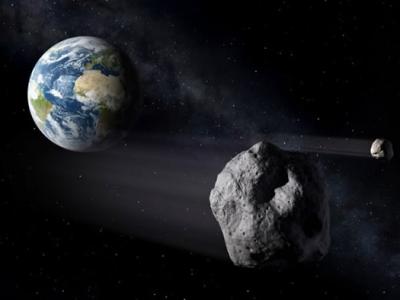
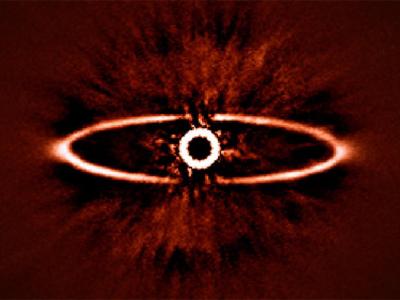
Researchers believe that this polluting material is falling in from a population of asteroids orbiting in a disk around the stars which get pulverized as they get gravitationally sucked into the stars.
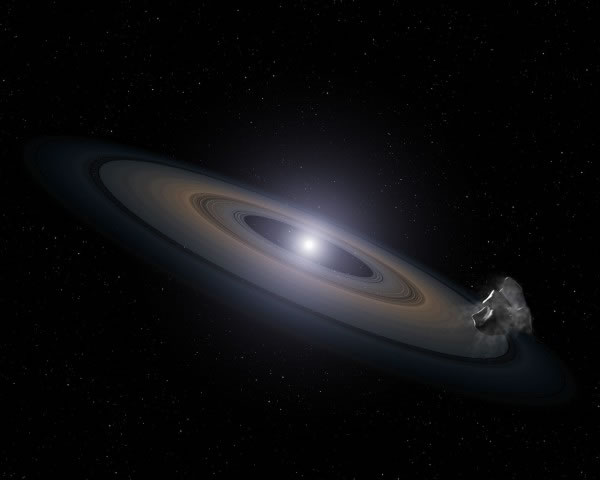
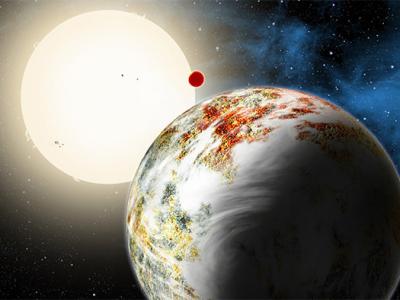
This is an artist’s impression of a a white dwarf with a disk of rocky debris left behind by the star’s surviving planetary system. Credit: NASA, ESA, and G. Bacon (STScI)
“When these stars were born, they built planets, and there’s a good chance they currently retain some of them. The material we are seeing is evidence of this,” said Farihi, an astronomer at the University of Cambridge in England.
“The debris is at least as rocky as the most primitive terrestrial bodies in our solar system.”
The stars, reside in the Hyades star cluster, in the northern constellation of Taurus (The Bull). The cluster is relatively young, at only 625 million years old. Until now, astronomers have had a hard time finding planets within young clusters like this because the stars at this stage in their lives may simply be too active and unstable .
But now this new planet-detection technique is giving a never-before-seen peek at the actual chemistry of rocky planets. What’s exciting is that just by looking at the ratio of silicon-to-carbon of the material they are measuring, researchers can tell how similar- chemically at least – exoplanets could be to our own.
Astronomers now have a new tool in their arsenal to better understand the chemistry that goes into making planets, and figure out if there could possibly be different recipes for making habitable worlds like our own.
The polluted white dwarf study appeared in the May 2 issue of the Monthly Notices of the Royal Astronomical Society.(Posted by Andrew Fazekas in StarStruck on May 10, 2013)