Volcano Theory of Dino Die-Off Gets New Support
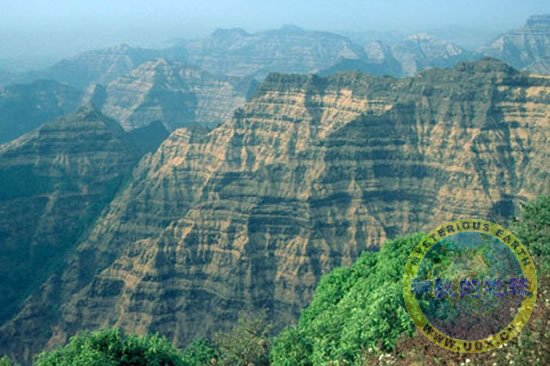
Layers of volcanic rock from the Deccan Traps eruptions make a telltale striated pattern in western India.
A new study suggests the Deccan volcanoes erupted as the dinos were dying off, providing additional evidence for the controversial theory that volcanic climate change—and not just a single giant asteroid impact—contributed to the death of the dinosaurs.
Richard A. Lovett
for National Geographic News
November 5, 2007
A series of gargantuan volcanic eruptions may have ended at nearly the same time that the dinosaurs went extinct, a new study shows.
The find bolsters a controversial theory that massive volcanism contributed to the global catastrophe known as the K-T extinction, which wiped out the dinosaurs and many of Earth's other organisms 65 million years ago.
Gerta Keller, a Princeton University paleontologist, presented the new research last week at a meeting of the Geological Society of America in Denver, Colorado.
She found that underwater portions of the ancient lava flows, known as the Deccan Traps, contained marine fossils only of species known to have existed after the extinctions.
In other words, all of the marine sediments that built up on the lava flows came from after the extinction.
"So we can say that the flows, which mark the end of the main phase, of the Deccan eruptions ended near the K-T mass extinctions," she said.
Worldwide Effects
For years, Keller and a few other scientists have suspected that the Deccan Traps played a role in the global catastrophe.
The eruptions would have been on a scale that dwarfed anything ever experienced by humans, burying parts of western India in nearly 12,000 feet (3,500 meters) of volcanic rock, they say.
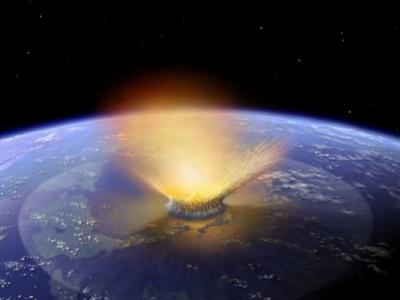
The effects worldwide would have been even worse, Keller said. Each of the flows would have released vast quantities of climate-altering gases—up to ten times as much as were produced by the famed Chicxulub asteroid impact in Mexico's Yucatan peninsula. Most scientists believe the Chicxulub impact is the major cause of the dino die-off.
The Deccan Traps devastation would also have occurred quickly.
"Each of these megaflows could have been formed in weeks, months, or years," Keller said, citing a study by French scientists.
Eighty percent of the lava was produced during a single pulse of eruptions, she added.
Coincidental Timing
But prior studies, based on radioactive elements contained in the lava, only showed that the lava flows and the extinctions occurred within about 300,000 years of each other.
So Keller followed a finger of lava across India and down an ancient river valley that channeled it all the way to the Gulf of Bengal, more than 900 miles (1,500 kilometers) from its source.
Some of that lava eventually wound up underwater and slowly accumulated marine sediments containing the fossils of plankton. But none contained species killed off during the K-T extinction, suggesting the flows ended around that time.
The correlation isn't perfect, Keller said. It's always possible that the lava flow ended slightly after the extinction—or even a few tens of thousands of years before—because the geological record isn't complete.
But, she added, "if someone wants to say that this kind of thing has nothing to do with [the] mass extinction—even if it ended 100,000 years earlier—they're out of their mind."
Still Open to Debate
Keller's arguments against Chicxulub as the lone dino-killer have long been contentious, and this one is no exception.
Greg Ravizza, a geochemist at the University of Hawaii who has studied seawater changes related to the Deccan volcanism, argued that Keller is focusing too strongly on when the volcanism ended.
"Keller and co-workers prefer an interpretation that concentrates the bulk of the Deccan volcanism very close to the K-T boundary," he said by email.
But the key question is when the major pulse of Deccan volcanism started, he pointed out.
Furthermore, he said, the lava flows Keller studied weren't even recognized as part of the Deccan volcanism until recently and are geographically isolated from the vast majority of the Deccan Traps.
"Whether or not the upper and lower traps at Rajahmundry [the location studied by Keller] can be claimed to fully represent the two largest and most extensive Deccan volcanic eruptions is still open to debate," Ravizza said.
Meanwhile, Keller's argument that the Deccan Traps eruption forced major climate change may have additional support.
Anne-Lise Chenet is one of the scientists whose radioactive decay studies helped confirm that the Deccan volcanism occurred within a few hundred thousand years of the K-T boundary.
She is also co-author of a study, soon to appear in the Journal of Geophysical Research Letters, that examined the volcanic gases emitted by the flows.
"The amount of sulfur dioxide emitted by each volcanic event ... [leads us] to reconsider the effect of volcanism ... on the climate and environment," she said by email.