Space Shuttle Mystery Partially Solved, NASA Says
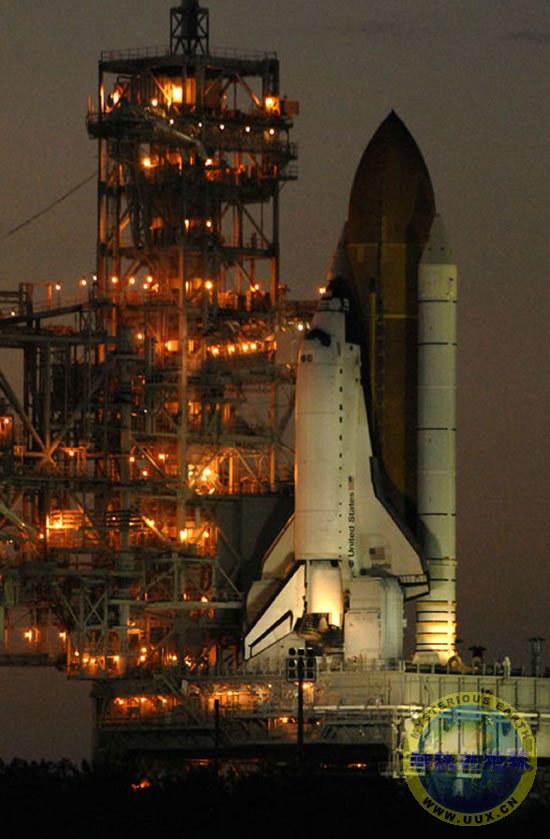
Space shuttle Atlantis sits on pad 39a in Cape Canaveral, Florida, at sunset after a launch was scrubbed December 9, 2007, due to faulty liquid hydrogen sensors.
NASA engineers this week announced that a bad connector was responsible for the erratic fuel-gauge readings.
The next launch will take place only after the problem has been fully fixed, a NASA official said.
Photograph by Paul Kizzle/AP
Marcia Dunn in Cape Canaveral, Florida
Associated Press
December 19, 2007
Fuel gauge failures in the shuttle Atlantis's tank have been traced to a bad connector, NASA announced Tuesday, and a top manager said he did not know how long it would take to replace the part or when the spaceship might fly.
The erratic shuttle fuel gauges—part of a critical safety system—forced back-to-back launch delays earlier this month. Before Tuesday's tanking test, NASA was aiming for a January 10 liftoff of Atlantis, which was scheduled to carry a European lab to the International Space Station.
"We're going to follow this trail where it leads us and we're going to solve this problem, and then we'll go fly ... whether it's January 10 or February 10 or March 10," shuttle program manager Wayne Hale said.
In orbit, meanwhile, spacewalking astronauts helped pinpoint the source of a flawed mechanism in the international space station's power system. But they unearthed few clues about an even bigger problem with a fouled rotating joint for the solar wings.
Spacewalking astronauts Peggy Whitson and Daniel Tani stopped first to inspect a solar wing-tilting mechanism that experienced circuit breaker trips on December 8. Engineers initially suspected a piece of space junk may have damaged it, but Whitson and Tani found no signs of impact. They temporarily disconnected cables for a test that exonerated certain parts, leaving the motor most likely at fault.
NASA's space station program manager, Mike Suffredini, said a spare motor already on board will be installed during Atlantis's visit, a difficult spacewalking job.
Repairs to the damaged solar rotary joint, on the other hand, will be a massive effort requiring as many as four spacewalks and likely will not be attempted until next fall, Suffredini said. That's how long it will take to figure out what's wrong and train a crew on the repairs, he said.
The joint is supposed to automatically rotate 360 degrees to keep the solar wings facing the sun. It's been used sparingly over the past three months, ever since it began vibrating and exhibiting electrical current spikes.
Whitson and Tani spent most of their seven-hour spacewalk inspecting the clogged rotary joint, removing covers and peeking deep inside with a dentist-style mirror on a rod. They found more of the metallic grit that was first detected by Tani during a spacewalk in October, and they collected more samples.
All the gears, motors and bearings looked fine, although some were dirtier than others. The spacewalkers removed one bearing for return to Earth on the next shuttle flight, for engineering analysis.
NASA had hoped to learn what was grinding against the rotating ring.
"We didn't find anything that stood out," Suffredini said. The space agency will try to limp along with the joint in its current state until repairs are made, he added.
Suffredini said that if both dilemmas persist, the space station may not be able to generate enough power to support the Japanese lab that is supposed to arrive in three sections beginning in February. There's "a fighting chance" to keep the first Japanese delivery mission on track, but beyond that, it would be "extremely difficult" to continue assembly, he said.
As for Atlantis's woes, two of the four fuel gauges at the bottom of the external tank failed during Tuesday's test, and another did not work right.
Special test equipment indicated open circuits in the connector that passes through the wall of the fuel tank, linking wiring between the gauges in the tank and Atlantis. It was too soon to know whether the shuttle would need to be returned to its hangar for repairs, Hale said.
The space agency has been struggling with sporadic fuel gauge problems for two years, ever since flights resumed following the 2003 Columbia tragedy (see story). The gauges prevent the shuttle's main engines from running on an empty tank, which could be catastrophic.
Hale said it's unclear whether the same type of connector caused the previous problems. There could be a manufacturing defect or flawed design, or the part may have been installed improperly, he noted. The connector is less than ten years old, "pretty new by shuttle standards."
"We are not going to be driven by schedule on this one," Hale said at a late afternoon news conference. "We need to get to the bottom of this, fix it and make sure it's fixed once and for all."
NASA is up against a 2010 presidential deadline for completing the space station and retiring the shuttles.
Copyright 2007 Associated Press. All rights reserved. This material may not be published, broadcast, rewritten, or redistributed.