Bangladesh Town Copes with Loss After Cyclone
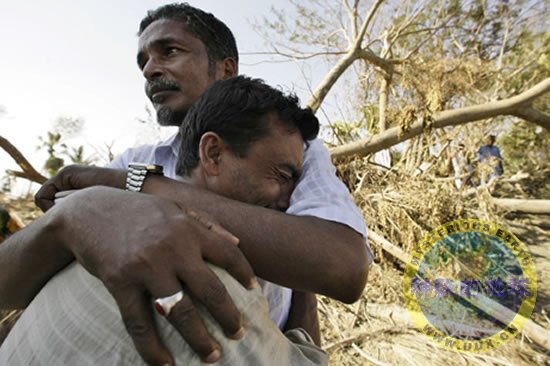
An unidentified villager is consoled by another man on Tuesday, November 20, 2007, after his daughter's body was recovered in Padma, a Bangladeshi village hit hard by last week's cyclone.
Although some aid had arrived in Padma, there was no steady source of clean drinking water Tuesday. Villagers said they will need help to recover from the loss.
Photograph by Saurabh Das/AP
Sam Dolnick in Padma, Bangladesh
Associated Press
November 20, 2007
In the days since a devastating cyclone struck impoverished Bangladesh, the village Padma has grappled with impossible questions.
What happens to a fishing community when its fishing boats are in splinters? What happens to a woman who watches her mother and baby daughter drown? And what will happen to Padma if the villagers don't receive clean drinking water soon?
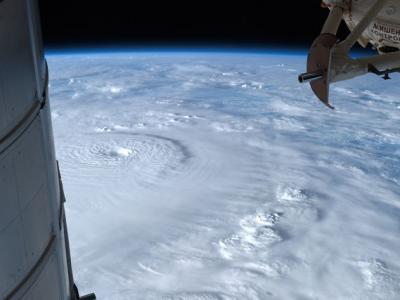
Padma is on the coast of the Bay of Bengal in the Barguna district, one of the areas hit hardest by Tropical Cyclone Sidr, which killed more than 3,150 people across Bangladesh last week.
Of 4,000 villagers scattered across rice paddies and coastline, Padma has counted 61 dead, and 14 others are missing, residents said Tuesday.
Some homes in the village were crushed like soda cans. Others were left intact, but tipped on their sides, windows facing the ground. Some flimsy huts vanished, leaving behind only water-swollen children's books and broken plates.
Danger Zone
"We have nothing," said Abdul Jabbar, 40, who lost his house in the storm and survived by climbing the tallest palm tree he could find. The water still nearly reached his feet.
"What should I do? I have nowhere to go," he said.
This low-lying country has seen devastating storms before—in 1991, about 140,000 died in one cyclone. The government responded by installing an emergency warning system and building thousands of shelters, including concrete boxes raised on pillars. The measures have helped save many lives.
Before Sidr struck, Bangladesh's government warned its citizens to leave low-lying areas, and some 1.5 million people made it to high ground or to shelters. But many didn't want to go or didn't move quickly enough, and Sidr was the deadliest cyclone in Bangladesh in more than a decade.
The people of Padma were warned, too. The speakers nestled in palm trees that usually sound the village mosque's call to prayer were used to tell people to evacuate their homes. Nearly half the residents responded, gathering in the concrete school at the edge of town.
But many villagers stayed in their homes. Some said they didn't think the storm would hit them, and others said they intended to go later. Some were trying to save their belongings.
Others were caught at sea.
Grieving
For many braving the storm would prove fatal.
By the time Haoa Begum, her baby, and her mother tried to leave home, the floodwaters had reached dangerous levels. They swam out in search of safety, with Begum's mother clutching the baby.
"But suddenly the baby was gone," Begum said.
The storm got worse and Begum was separated from her mother as well. She found her hours later when the water receded, covered in mud. Her mother later died. The baby's body was found two days later.
"I have nothing now," said Begum, who also lost an uncle and a cousin, as well as the home they all shared. "I sleep at other people's homes. What can I do?"
In the village the grief was almost unbearable.
One mother wailed by the spot where her son's grave used to lay, before the storm washed it away.
One plot over, a family prepared a funeral for a six-year-old. Through a flooded rice paddy, the boy's uncle carried the child's body on his head, wrapped in a blue tarp and laid out on plywood.
Nearby, a carpenter tried to understand how his infant nephew had washed out of his grasp.
"No Net"
Then there was the canal at the village's heart, clogged with piles of broken fishing boats. Hulls were smashed, bows were cracked, and shattered wood was everywhere.
Nearly every family in Padma has at least one fisherman, and if the boats are not repaired soon, the already bleak situation could get worse.
Khalilur Rahman, for one, wasn't going to let that happen.
He began fixing his boat Friday, the day after the storm, and by Tuesday he thought the vessel was ready for the sea. But getting it there was a challenge.
Rahman recruited about 50 of the village's young men to heave the boat out of a mud pit and up the ravine where it had been tossed by the storm. Progress was slow, but Rahman, who lost his home and his 12 cows, said he was determined.
"What is gone is gone," he said.
Much-needed relief has begun trickling into Padma. An international aid group brought rice, and another brought high-energy cookies. A doctor, funded by the Atlanta, Georgia-based aid group CARE USA, had seen more than a hundred patients in a clinic set up across from piles of twisted roofs and fallen trees.
But getting enough clean drinking water remained difficult, and some residents said they need long-term help.
Oliol Islam, a fisherman, was one of several men who said he needed loans and other financial assistance to rebuild his boat and provide for his family.
"I have no net, no boat, nothing," he said. "I need help to restart."
Copyright 2007 The Associated Press. All rights reserved. This material may not be published, broadcast, rewritten, or redistributed.