Yeti Robot Detects Crevasses
Meet Yeti—the robot that’s making life easier for polar scientists.
No, it doesn’t look like a giant white ape. But the battery-powered rover has all the toughness of an abominable snowman, surveying undetected hazards at research sites in Greenland and Antarctica.
Now, after six years of operation, a new study shows that Yeti and other polar robots have “great potential” to improve the safety and efficiency of scientific work at the poles.
“It’s simple and inexpensive, yet effective,” said Laura Ray, an engineer at Dartmouth University College and Yeti project leader.
“On a $20,000 budget, designing from the ground up, undergraduates designed [and] fabricated a very reliable robot.”
The robot was designed and built to roam the poles by a team of Dartmouth engineering students with a grant from the U.S. National Science Foundation. It’s a “testimony to their capabilities that Yeti has been so successful,” she said.
Yeti Power
As more scientists work at the poles—studying subjects from climate change to the cosmos—it’s important that the areas they work in are safe, since polar regions are scarred with crevasses, or deep voids.
Yet many people still search for crevasses by using manual ground-penetrating radar surveys—exposing crews to possible risks.
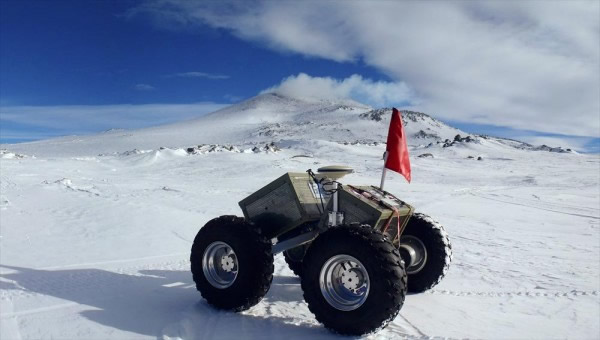
Yeti robot in front of Mt. Erebus, Antarctica. Photograph courtesy Kirsten L. Mabry
But the four-wheel drive Yeti removes this danger by accurately detecting treacherous terrain via ground-penetrating radar and global positioning systems (GPS).
A new study, published in the March/April issue of the Journal of Field Robotics, found that Yeti operated reliably at temperatures of -22 degrees Fahrenheit (-30 degrees Celsius), moved well over uneven snow, and acquired data on hundreds of crevasse encounters—which will help scientists identify where crevasses are, according to the authors.
The 160-pound (73-kilogram) robot is also lightweight enough that it can travel across crevasse bridges without falling in, said Ray.
So far Yeti’s been deployed on 12 projects, including one at the South Pole, where the robot discovered three buried buildings that could have been hazardous for people working in the area. (Read a first-person account of visiting the South Pole).
Ray hopes that Yeti can help scientists beyond finding dangers—for example, the rover’s data on crevasses can be used by scientists studying how ice sheets are changing as the world heats up.
So what would Yeti say if she could talk? “This is fun,” Ray suggested. “Yeti gets to … see the world.”
Posted by Christine Dell'Amore of National Geographic News in Weird & Wild on April 16, 2013