Major Earthquake Hits Northern Chile, Injures 20
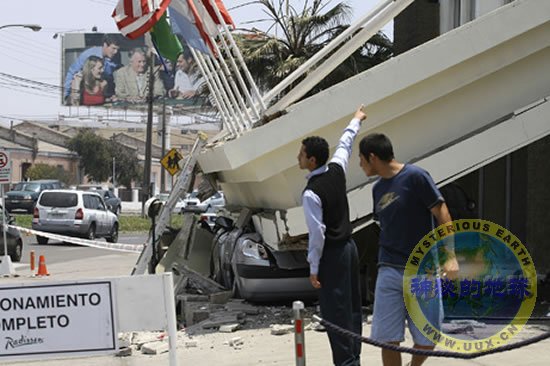
Residents watch a roof that collapsed on a car in Antofagasta, Chile, after an earthquake on November 14, 2007.
A powerful 7.7 magnitude quake hit the country's mineral-rich north, injuring at least 20 people, damaging buildings, and halting operations at some of the world's biggest copper mines.
Photograph from Reuters
By Eduardo Gallardo in Santiago, Chile
Associated Press Writer
November 14, 2007
A major earthquake struck northern Chile on Wednesday, toppling power lines, closing roads, and sending terrified residents into the streets.
Authorities reported 20 injuries but no deaths from the quake, which was felt in the capital as well as neighboring Peru and Bolivia.
The earthquake, which struck at 12:40 p.m. local time (10:40 a.m. EST), measured magnitude 7.7 and was centered 780 miles (1,255 kilometers) north of Santiago, or 25 miles (40 kilometers) east-southeast of Tocopilla, the U.S. Geological Survey said. The USGS said it occurred about 37 miles (60 kilometers) underground. (See map.)
The U.S. Pacific Tsunami Warning Center issued, then canceled a tsunami warning for Chile and Peru. It said the quake generated only a 2-foot (60-centimeter) wave.
Aftershocks were felt in several cities, according to media reports from the area.
Some houses were damaged in the port city of Tocopilla, according to Deputy Interior Minister Felipe Harboe, "and some people were injured, apparently none seriously."
The government's Emergency Bureau said at least 20 people were injured in the small town of María Elena. A number of houses were damaged there, said Mayor Eduardo Ahumada.
Presidential spokesperson Ricardo Lagos Weber said power was cut in several cities in northern Chile.
The region is home to some of the country's largest copper mines.
A statement from mine operator Codelco (Corporación Nacional del Cobre) reported no "relevant" damage but said its mines in the region were without power and only emergency teams were operating. Only minor landslides were reported, it said.
Television images showed cars crushed by the collapse of a hotel entryway in Antofagasta, 105 miles (170 kilometers) south of the epicenter.
A reporter for Radio Cooperativa said she saw cracks in the tarmac at the airport in Antofagasta.
Schools, hospitals, and other buildings were evacuated in several cities.
"It was horribly strong," said Andrea Riveros, spokesperson for the Park Hotel in Calama, 60 miles (95 kilometers) from the epicenter and site of the large Chuquicamata copper mine.
"It was very long and there was a lot of underground noise," she said, adding that the quake knocked out power to the hotel but caused no damage.
At the nearby Agua del Desierto Hotel, administrator Paola Barria said she felt like she was riding on "a floating island."
She reported downed power lines, cracked windows, and fallen pieces of houses near the hotel.
"I was very frightened. It was very strong," she said. "I've never felt one that strong."
In the Bolivian capital of La Paz, 385 miles (620 kilometers) northeast of the epicenter, some high-rise buildings were evacuated, but there was no apparent damage and people soon returned to their offices.
Stretching along the earthquake-prone Pacific Ring of Fire, Chile has suffered many destructive temblors. A 1939 quake killed 28,000 people, and in 1960 a magnitude 9.5 quake killed 5,700 people. That remains the most powerful quake on record.
On June 13, 2005, a magnitude 7.8 quake near Tarapacá in northern Chile killed 11 people and left thousands homeless.
Copyright 2007 The Associated Press. All rights reserved. This material may not be published, broadcast, rewritten, or redistributed.