Wood May Be Key to Confirming Captain Kidd's Ship
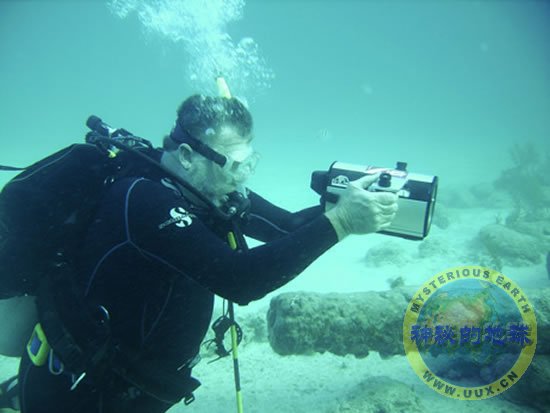
Archaeologist Charles Beeker examines possible wreckage from Captain Kidd's ship, the Quedagh Merchant.
Beeker said he's convinced the wreck is Kidd's ship, but it will take about two years of careful excavation to confirm the vessel's identity.
Photograph courtesy Indiana University
Willie Drye
for National Geographic News
December 18, 2007
The craftsmanship of 17th-century shipwrights could be a major factor in confirming that archaeologists have found the wreck of a ship that once belonged to the legendary Captain Kidd.
Researchers announced last week that they'd found a wreck off the coast of the Dominican Republic that they think is the Quedagh Merchant, which belonged to Captain William Kidd, a Scottish privateer who was convicted of piracy and hanged in London in 1699.
Charles Beeker, an archaeologist at Indiana University who made the discovery, said he's convinced the wreck is Kidd's ship. But he said it will take about two years of careful excavation to confirm the vessel's identity.
The wreck consists largely of a pile of cannons and anchors. But if excavators can find a few pieces of wood from the ship, that could go a long way toward identifying it, said Richard Zacks, author of The Pirate Hunter: The True Story of Captain Kidd.
Zacks said that before his death, Kidd bragged to a British nobleman that the Quedagh Merchant, a Moorish ship he'd captured in the Indian Ocean, was held together with a kind of woodworking joinery called rabbeted seams.
That type of seam was an "old-fashioned method" that shipwrights used to join the boards of wooden sailing ships, said Marvin Spencer, who builds wooden sailboats in Plymouth, North Carolina.
A rabbeted seam would make a tighter seal and also help a sailing ship withstand the tremendous forces of sea and wind, Spencer said.
"The stresses on the ship would be incredible," Spencer said, especially if the ship was loaded with cargo.
Thanks to rabbeting, the seams would give instead of break apart, but they would not give enough to spring a leak, he said.
That rugged craftsmanship is what prompted Kidd to brag about the Quedagh Merchant.
Other telltale clues to the identity of the shipwreck would be fragments of wood that could be traced to Asia, where the Quedagh Merchant was built, Zacks said.
Pirate or Privateer?
Historians think that Kidd abandoned the Quedagh Merchant in 1699 when he went to England to try to clear his name of piracy charges.
After he left, looters removed valuables from the ship, then set fire to it and set it adrift down the Rio Dulce in what is now the Dominican Republic.
The ship sank about 70 feet (20 meters) off Catalina Island (see map).
Kidd had been authorized by England to operate as a privateer, Zacks said. This meant that under certain conditions, he could legally seize ships on the high seas.
Kidd may have slightly exceeded the limits of his license as a privateer a few times, but his transgressions did not rise to the level of piracy, Zacks said.
"He thought of himself as a respectable privateer," he said.
(Read related story: "Modern Pirates Terrorize Seas With Guns and Grenades" [July 6, 2006].)
Beeker said Kidd went to England thinking his influential friends in Parliament could help him clear his name.
But that proved to be a fatal miscalculation—his powerful friends did not back him.
"[Kidd] was wrapped up in the wrong politics," Beeker said. "The poor man was railroaded to his death."
Willie Drye is the author of Storm of the Century: the Labor Day Hurricane of 1935, published by National Geographic Books.