Shuttle Launch Postponed Again Over Fuel Gauge
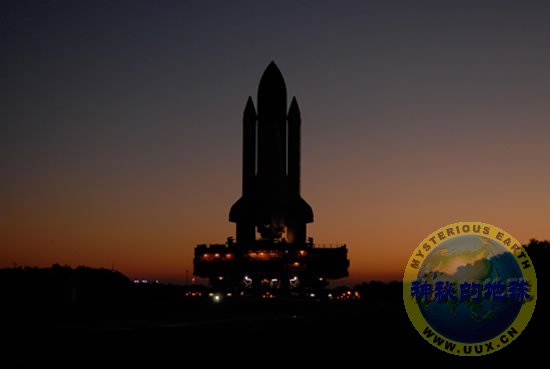
A silhouette against the rising sun Thursday, December 6, 2007, space shuttle Atlantis rode a crawler-transporter to the launch pad before liftoff was postponed due to incorrect fuel gauge readings.
If Atlantis isn't flying by next week, sun angles and computer concerns will delay the launch until January, the Associated Press reported.
Photograph by Kim Shiflett, courtesy NASA
Marcia Dunn in Cape Canaveral, Florida
Associated Press
December 7, 2007
NASA called off Thursday's launch of space shuttle Atlantis after a pair of fuel gauges in its large external tank failed to work properly, a recurring problem ever since the 2003 Columbia Disaster.
Shuttle managers said the next launch attempt would be no earlier than Saturday.
Atlantis is loaded with a European space station lab, Columbus, that has been waiting for years to fly to the international space station.
Scientists to "Sleep on It"
After meeting well into the evening, shuttle managers decided to forgo a Friday launch attempt to give engineers more time to figure out what was wrong and, quite possibly, work around the problem.
"We want to sleep on it," said LeRoy Cain, chairman of the mission management team. "We want to encourage the engineers and the rest of the team to sleep on it and think about what we might not be thinking about yet."
Preliminary indications suggested the problem might be with an open circuit rather than the gauges themselves—perhaps a spliced line or bad connector—which would be easier to fix.
Two of the four engine-cutoff sensors failed a standard preflight test Thursday morning as Atlantis was being fueled with liquid hydrogen. Three are required to provide accurate readings in order to proceed with a launch, although NASA is considering the possibility of flying with fewer sensors working.
The sensors are part of a critical backup system to ensure that the shuttle's three main engines don't shut down too soon or too late during liftoff, a potentially disastrous problem. Troubles with the sensors have delayed shuttle launches before, most recently in September 2006.
"We really are scratching our heads," said launch director Doug Lyons.
Because the problem is believed to be in wiring between Atlantis and the external fuel tank, the shuttle's engine compartment remained sealed and no repairs were planned, at least for now.
"Fly When It's Safe"
Thursday's postponement was a disappointment for the European Space Agency. The 2-billion-U.S.-dollar lab has been in the works for nearly a quarter-century, and was held up for years by NASA's repeated space station design problems and, more recently, the 2003 Columbia tragedy.
"Of course we would love to fly on time, but we want to fly when it's safe," said Alan Thirkettle, the European space station program manager.
The postponement ended NASA's streak of on-time shuttle launches this year. Each of the year's previous three countdowns ended in on-the-dot departures.
Because of poor sun angles and computer concerns, NASA will have to wait until the beginning of January to launch Atlantis if it isn't flying by next Thursday or Friday.
When the fuel sensors failed, the launch was still more than eight hours away, and shuttle commander Stephen Frick and his six crewmates had yet to climb aboard.
The three astronauts aboard the international space station were disappointed by the news, which they heard from Commander Frick via Mission Control.
"He says that he's sorry they're going to be a little bit late, and they'll get there as soon as they can," Mission Control radioed the space station crew. "Aw, that was sweet," commander Peggy Whitson replied from orbit.
——
Associated Press writer Brian Skoloff contributed to this report.
Copyright 2007 Associated Press. All rights reserved. This material may not be published, broadcast, rewritten, or redistributed.