Dinosaur Eggs Are Missing Link In Egg Evolution
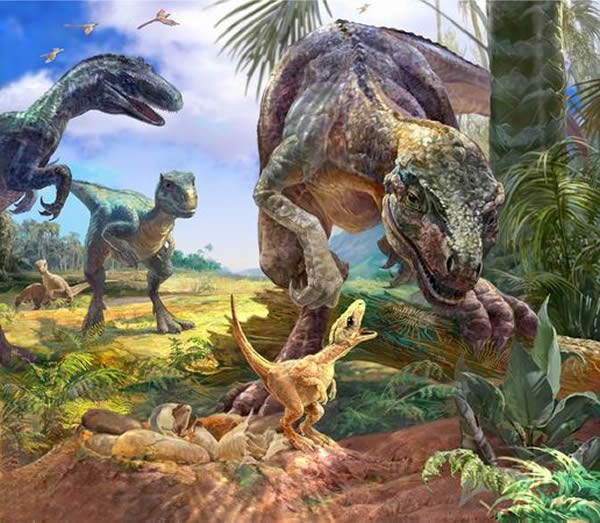
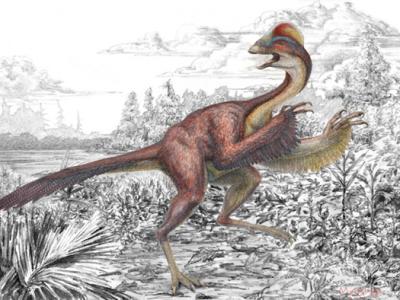
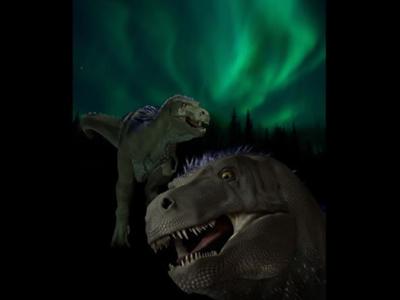
A megalosaurid theropod overlooking its nest.
Studying dinosaur eggs is a lot like a big, frustrating Easter egg hunt: The eggs are rare, fragile—rainwater is acidic enough to dissolve some egg fossils—and it can be difficult to identify which dinosaur species they belong to.
But every now and then, scientists' persistence pays off. A recently discovered clutch of 150-million-year-old fossil eggs is being billed as an important missing link in the evolution of dinosaur eggs.
The find from the Late Jurassic period, described in a paper published May 30 in the journal Scientific Reports, gives scientists a picture of early dinosaur eggs and embryos from a group called theropods, which include Tyrannosaurus rex and modern birds.
"Most of the time, you find eggs without the embryos, or the embryos without the eggs," said said Ricardo Araújo, a vertebrate paleontologist at Southern Methodist University in Dallas, Texas and lead author of the new study.
This is the first real picture of what early eggs in theropods might have looked like, said Robert Reisz, a vertebrate paleontologist at the University of of Toronto, who was not involved in the study.
The find will enable researchers to begin to address questions like which aspects of theropod eggshells came from their ancestors, and which ones evolved independently.
Gaps in The Record
Much of the fossilIzed egg material that scientists have found up till now belongs to the theropods, and dates to the Cretaceous period—about 80 million years ago. There are older dinosaur eggs from the Early Jurassic, or about 190 million years ago, but they belong to a sister group of dinosaurs called the sauropods.
"There's a real gap in the record for theropod dinosaur eggs and nests," wrote Matthew Carrano, a vertebrate paleontologist at Smithsonian's Natural History Museum, in an email this week. "We have very little from anything outside Coelurosauria, the group that includes birds."
That shortage has frustrated scientists because many of the bird-like aspects of reproduction seem to have appeared during the gap, said Carrano, who was not involved in the study but who sometimes collaborates with one of its authors.
"The next closest animals, sauropod dinosaurs, are pretty far removed from birds and show us only a condition that was still not very bird-like," Carrano said. "So finding nests from [early] theropods is pretty important to understanding this story."
A Better Picture
"Before, we knew nothing about how the eggs looked [for early] theropods," said Araújo, a former National Geographic grantee.
So the scientists used a combination of high-resolution x-rays and CAT scans to delve into the structure and appearance of the embryos and eggshells, which were discovered in the Lourinhã Formation on Portugal's west coast in 2009.
They now know that these early theropod eggs—which belong to a group called Trovosaurus—contain more irregular, external ridges than later theropod eggs. "It reminds me a little bit of a honeycomb pattern," Araújo said.
The eggs are built with a single outer layer, as opposed to the two or three layers seen in later theropod groups and modern birds.
They're also extremely porous—more so than crocodile eggs. "This tells us that the eggshells were buried," explained Araújo, and that the pores allowed gas exchange between the inside and outside of the egg.
Surprise Inside
What made the Portugal findings so unusual was that they embryos were developed enough to narrow down the group of dinosaur that deposited them.
Absence of embryos in the eggs makes it hard, and often impossible, to determine which dinosaur laid them.
David Varricchio, a vertebrate paleontologist at Montana State University in Bozeman who was not involved in the study, said that bone formation occurs well into a dinosaur embryo's development.
And to have skeletal features developed enough to identify a specific group of dinosaur, "that happens in the last week or so of incubation," he explained.
Jane J. Lee
National Geographic
Published May 30, 2013