Photo: Galaxy Crash Revealed First Time in X-Rays
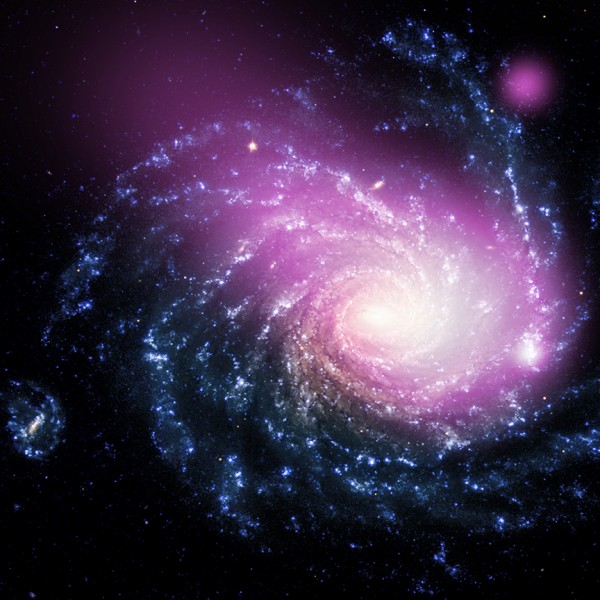
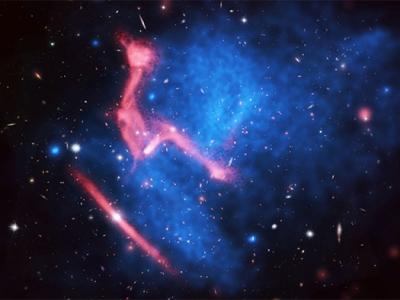
A massive cloud of gas glowing in x-rays inside a galaxy 60 million light years away has been revealed by Chandra Observatory that have been combined with optical data from the Very Large Telescope in this composite image. The hot gas cloud is likely caused by a collision between a dwarf galaxy and a much larger galaxy. Credit: X-ray: NASA/CXC/Huntingdon Inst. for X-ray Astronomy/G.Garmire, Optical: ESO/VLT
For the first time astronomers have been able to peer into the heart of a galaxy 60 million light years from Earth and observe, via x-rays, the remnants of a titanic collision between a long dead dwarf galaxy and much larger galaxy.
Astronomers have seen many examples across the universe of galactic collisions but now thanks to the X-ray views of NASA’s Chandra observatory of one particular spiral galaxy, dubbed NGC 1232, we may have not only a new way to hunt for them but also some hints to how galaxies grow by cannibalizing their smaller siblings.
A giant comet-shaped gas cloud heated to many millions of degrees appears on Chandra’s newly released images and is believed to have formed from shock-waves generated during the violent cosmic crash. Up until this new x-ray observation, the remnants of the small galaxy and the crash scene had been invisible in optical wavelength views of the beautiful, pinwheel shaped galaxy.
The smaller purple, x-ray emission on the right-hand side of the above image is thought to be a newly formed site of intense star formation nestled within one of the outer spiral arms of the galaxy, and was probably also triggered by the initial shockwave blast from the collision.
While the exact three-dimensional shape of the x-ray emissions is still unknown, it could be anywhere from 40,000 to 3 million times the mass of our sun. Expectations are that the collision process is still ongoing and will go on for another 50 million years.
NASA is so impressed with Chandra’s ability to probe inside this distant galaxy, they are betting that x-rays may be a great new technique for hunting down other sites of galactic collisions across the cosmos.(Posted by Andrew Fazekas in StarStruck on August 15, 2013)