England Begins Controversial Badger Cull
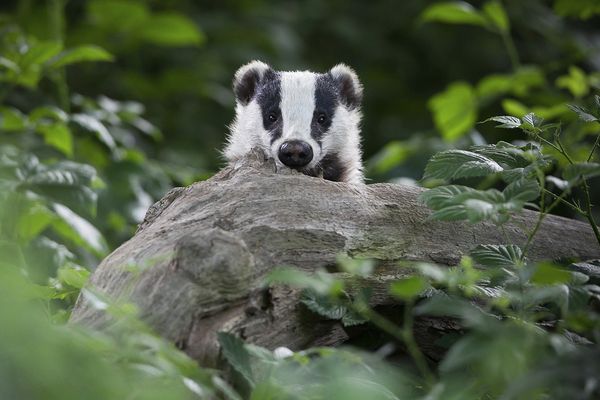
A European badger peeks out from behind a tree stump.
Despite petitions, threats from animal rights activists, and Parliamentary debate, a controversial badger cull is under way in England, the BBC reports.
A badger, for those not acquainted with the species, is a mammal about three feet long with gray fur, a mouthful of sharp teeth, and a black-and-white face striped like a zebra crossing. Meles meles, the European badger, is indigenous to the United Kingdom, lives in an underground labyrinth of tunnels called a sett, and feeds on worms and grubs. There are about 300,000 badgers in England.
The badger has been around long enough to have survived two ice ages, but thanks to a Conservative-dominated coalition government plan, some 5,000 will not survive a culling policy that aims to reduce the spread of tuberculosis (known to be carried by badgers) in cattle.
In 1971, a dead badger was discovered in a barn in Gloucester, autopsied, and found to be infected with TB. The concern—that badgers transmit the bacterium to cows, thereby putting a farm at risk of being shut down until the infection has cleared—has enmeshed scientists, politicians, government bureaucrats, and farmers ever since.
Opposition Gathers Steam
Last year, the Department for Environment, Food and Rural Affairs (DEFRA) announced its intention to test the "safety, humaneness, and efficacy" of culling by targeting 5,000 badgers in Gloucestershire and Somerset—two infection hot spots.
As the proposed cull drew closer, the controversy widened to include celebrities like Queen guitarist Brian May, who led a protest march in London in June and recorded a song called "Badger Swagger"; the rock star Meatloaf; and actress Dame Judi Dench, who posted a video on YouTube calling for a stop to culling.
An anti-culling petition drew hundreds of thousands of signers, and there's an online threat of a voodoo curse on Environmental Secretary Owen Patterson, a hard-line advocate of the cull. Others have weighed in with tweets, blogs, and letters to the editors of British newspapers. "Cull the politicians instead," one reader wrote in the Daily Mail. On the other side, a farmer's wife pointed out that "we wouldn't be having any of this nonsense if this was about culling rats."
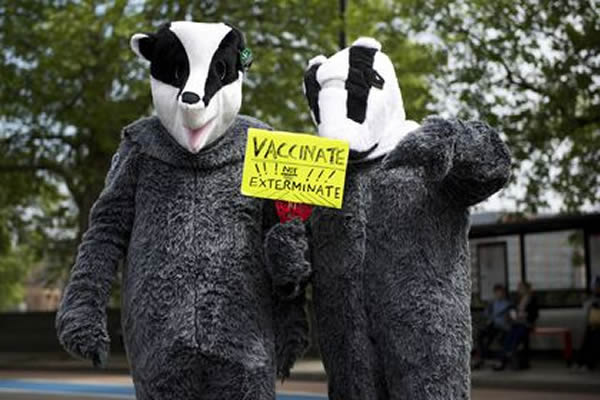
Hundreds of people wear black and white costumes to join the National March Against the Cull in central London.
Costly Issue
According to DEFRA, bovine TB cost taxpayers £100 million last year. Over the next decade costs are estimated to rise to £1 billion. In the late 1990s, the government appointed an independent commission to study the problem. Ten years and £50 million later, the report, "Bovine TB: The Scientific Evidence," concluded that the overall benefits of proactive culling were modest, and that "given its high costs and low benefits we therefore conclude that badger culling is unlikely to contribute usefully to the control of cattle TB."
A DEFRA spokesperson disputes that, however, and says that since the report was published, further research has shown that the benefits of reducing TB remain for many years after culling has stopped. According to a DEFRA statement, "No other country has successfully tackled bovine TB without addressing infection in both wildlife and cattle."
Bovine TB is rarely transmitted to humans—the number of cases in the UK is very small, and pasteurization kills the bacteria in milk. It is possible, says Nigel Gibbons, DEFRA's chief veterinarian, for people who work or live closely with infected animals to contract TB by inhaling the bacteria or coming into contact with the animals' secretions.
The economic impact on farmers whose cows test positive, however, can be profound. A farmer whose operation is shut down by infection can be out of business until the infection clears, which could take months; the cows are, in effect, quarantined. TB vaccination for cattle and badgers has its own set of complications. Current testing is not sophisticated enough to distinguish between cows vaccinated for TB and those infected by it. The effectiveness of the injected badger vaccination, depending on whose figure you take, is between 65 and 73 percent. Studies are going forward to develop a better oral vaccine for badgers, as well as a more sophisticated test for bovine TB in cows.
The controversy is full of biological complexities, colored by politics, and awash in contentious statements. "The policy appears to be little more than a sop to [the] farming sector," the executive director of the Humane Society International/UK wrote in a piece on the website Badgergate. "The only way we can do this [control bovine TB] is to cull," the head of the British Veterinary Association told the Telegraph.
Look Out, Mr. Badger
Plans are to use professional marksmen with rifles and shotguns over a six-week period. Animal rights activists have threatened to disrupt culling activity, though Avon and Somerset Chief Constable Nick Gargan told the BBC his force has been prepared for some time.
"It will end up in a mess," predicts Chris Cheeseman, a former scientific adviser to the government who has spent 35 years studying badgers. "It's not supported by science. It will not solve the problem. It is not cost-effective. And it will probably make it worse."
The debate has some quintessentially British aspects to it. "To some extent, it's a rerun of the fox-hunting debate, a split between town and country," explained cultural anthropologist Sean Carey, a research fellow at the University of Roehampton's Department of Social Science. "The townie has a romanticized version of the badger, which has a privileged place in English literature. Mr. Badger in The Wind in the Willows is an outsider but has heroic qualities. The country farmer, on the other hand, prides himself on realism. It's a case of 'let's get rid of the sentiment and get practical.'"
Cathy Newman
National Geographic
Published August 28, 2013